
Reading imaginary phonons near Γ: artifact or instability?
A negative (imaginary) frequency in a phonon dispersion is read as a dynamical instability — the crystal can lower its energy by freezing in that displacement pattern. But before believing any soft mode, especially one at or near \(\Gamma\), it pays to separate genuine physics from numerical artifacts.
Case in point: monolayer 1T-SnSe₂
Here is the kind of result that motivates all of this — a phonon calculation for a 1T-SnSe₂ monolayer, one of the systems I actually work on:
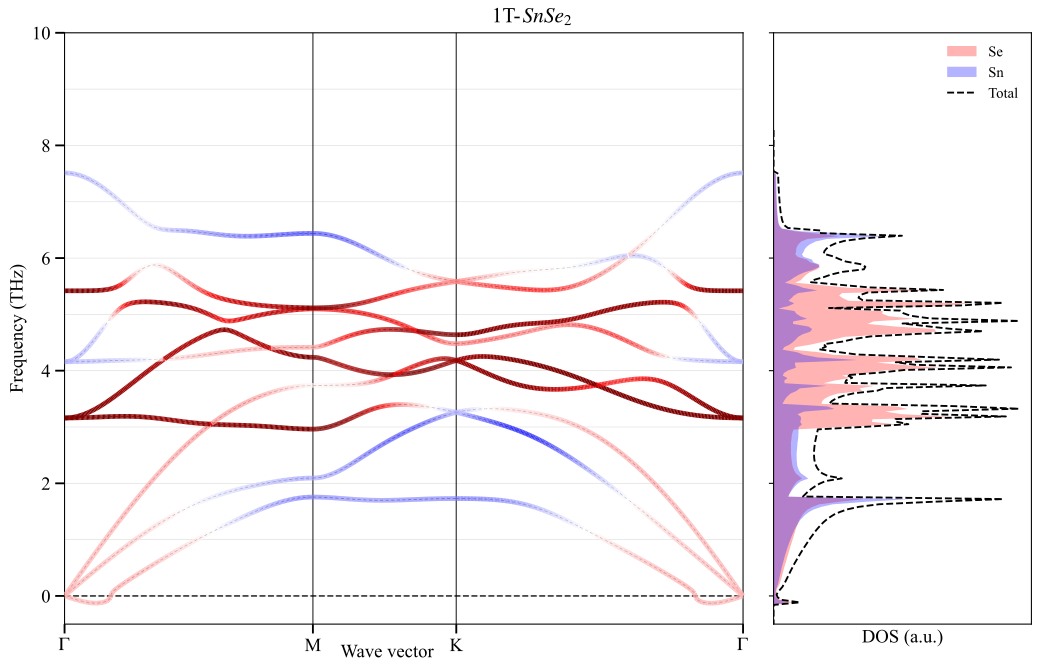
Look near \(\Gamma\). The lowest branch — the out-of-plane flexural (ZA) mode — does not sit cleanly at zero; it dips a hair below it on both sides of the zone center. Taken at face value, that imaginary frequency says the freestanding monolayer is dynamically unstable: it would rather buckle than stay flat.
I do not believe it for a second, and neither should you. 1T-SnSe₂ is a real, experimentally known layered semiconductor; a freestanding monolayer that genuinely wanted to corrugate would be a remarkable claim, not a blemish on a band-structure plot. Everywhere else in the BZ the branches are clean and positive. The only defect is a small imaginary ZA pocket sitting exactly at \(\Gamma\) — which is the single most artifact-prone place a soft mode can appear. The rest of this post is the machinery for being sure, and at the end I come back to what is actually going on in this figure.
The dynamical matrix
The harmonic phonon frequencies \(\omega_{\mathbf{q}\nu}\) are eigenvalues of the dynamical matrix built from the interatomic force constants \(\Phi\):
\[D_{\alpha\beta}^{\kappa\kappa'}(\mathbf{q}) = \frac{1}{\sqrt{M_\kappa M_{\kappa'}}} \sum_{l'} \Phi_{\alpha\beta}^{0\kappa,\,l'\kappa'}\, e^{\,i\mathbf{q}\cdot\left(\mathbf{R}_{l'} - \mathbf{R}_{0}\right)}, \qquad \det\!\left[ D(\mathbf{q}) - \omega_{\mathbf{q}\nu}^2\, \mathbf{1} \right] = 0 ,\]where \(\kappa\) indexes basis atoms, \(\alpha,\beta\) Cartesian directions, and \(l'\) runs over lattice vectors.
Why Γ is special
Translational invariance forces the acoustic sum rule (ASR): a rigid shift of the whole crystal costs no energy, so
\[\sum_{l'\kappa'} \Phi_{\alpha\beta}^{0\kappa,\,l'\kappa'} = 0 \quad\Longrightarrow\quad \omega_{\Gamma,\nu}^{\text{acoustic}} = 0 .\]In practice the ASR is only satisfied to within the numerical accuracy of your force constants. Residual drift shows up precisely as small spurious frequencies at \(\Gamma\) — sometimes a few cm⁻¹, sometimes a deceptively large few THz if the basis or grid is poor.1
Beyond translation: rotational invariance and the Huang conditions
The translational ASR is the sum rule everyone enforces — it is what phonopy’s FC_SYMMETRY
and the standard acoustic-sum-rule correction impose. But it is only one of the invariance
conditions the harmonic lattice potential must satisfy at equilibrium, and for low-dimensional
systems it is emphatically not the binding one.
The complete set, the Born–Huang invariance conditions, follows from the conservation of total linear and angular momentum — Noether’s theorem applied to the lattice potential.2 At equilibrium the first-order IFCs vanish, and the constraints on the second-order IFCs collapse to three. Writing \(\Phi_{\kappa\alpha,\kappa'\beta}\) for the force constant between atom \(\kappa\) in the reference cell and atom \(\kappa'\) anywhere in the Born–von Kármán supercell (so \(\kappa'\) now subsumes the cell index \(l'\)), and \(\tau_{\kappa\alpha}\) for equilibrium positions, they read:
Translational invariance — the ASR above, rewritten as a sum over supercell atoms:
\[\sum_{\kappa'} \Phi_{\kappa\alpha,\kappa'\beta} = 0 .\]Rotational invariance (Born–Huang) — the IFCs weighted by equilibrium positions are constrained pairwise:
\[\sum_{\kappa'} \Phi_{\kappa\alpha,\kappa'\beta}\,\tau_{\kappa'\gamma} = \sum_{\kappa'} \Phi_{\kappa\alpha,\kappa'\gamma}\,\tau_{\kappa'\beta} .\]The Huang (equilibrium) conditions — not a rotational constraint but the statement that the stress tensor vanishes:
\[\sum_{\kappa\kappa'} \Phi_{\kappa\alpha,\kappa'\beta}\,\tau_{\kappa\kappa'\gamma}\,\tau_{\kappa\kappa'\delta} = \sum_{\kappa\kappa'} \Phi_{\kappa\gamma,\kappa'\delta}\,\tau_{\kappa\kappa'\alpha}\,\tau_{\kappa\kappa'\beta} ,\]with \(\tau_{\kappa\kappa'\gamma} = \tau_{\kappa'\gamma} - \tau_{\kappa\gamma}\) the interatomic separation along \(\gamma\). These three, together with space-group and permutation symmetry, are the complete description of the invariance conditions at equilibrium.3
Two things are worth internalizing. First, the rotational and Huang conditions are violated by
exactly the same numerical pathologies as the translational ASR — incomplete basis sets, sparse
Brillouin-zone sampling, finite-displacement noise — so the basis-set discipline from the
checklist below is doing double duty. Second, and far less obvious: phonopy’s FC_SYMMETRY
imposes neither the rotational invariance nor the Huang condition. It symmetrizes the IFCs under
permutation and enforces the translational sum rule, and it stops there. If you converge your force
constants, switch on FC_SYMMETRY, and still see a misbehaving acoustic branch near \(\Gamma\),
you have not ruled out an artifact — you have only ruled out the translational one.
The 2D trap: the flexural (ZA) branch
This is where it bites, and it bites precisely in the systems I work on — monolayers and few-layer heterostructures. In a 2D crystal the out-of-plane flexural acoustic (ZA) branch should disperse quadratically, \(\omega_{\mathrm{ZA}}(\mathbf{q}) \sim q^2\), in the long-wavelength limit, with a polarization that is purely out-of-plane (along the vacuum direction). That \(q^2\) law is the lattice-dynamical fingerprint of a membrane’s bending rigidity, and it is universal across low-dimensional crystals.4
What a finite-displacement or DFPT calculation actually hands you, more often than not, is a ZA branch that is linear near \(\Gamma\) — or worse, one that dips to small imaginary frequencies just off the zone center (the SnSe₂ figure at the top is precisely this). For years a linear or slightly soft ZA was read as borderline dynamical instability.4 It usually is not. Lin, Poncé, and Marzari showed cleanly that the linear (or imaginary) ZA branch is the signature of two violated conditions: broken rotational invariance and residual stress.3 Restore both — enforce the Born–Huang rotational invariance and the Huang vanishing-stress condition — and the leading linear term cancels identically, leaving the physical \(q^2\) branch with purely out-of-plane polarization.
The roles split in an instructive way. For a high-symmetry, centrosymmetric monolayer like graphene the rotational invariance is automatically satisfied by symmetry, so the Born–Huang correction does nothing; it is the Huang (vanishing-stress) condition that straightens the ZA branch into a parabola.3 Drop the inversion center — MoS₂ is the canonical case — and the vanishing-stress condition alone is no longer sufficient: you need the rotational invariance as well.3
And here is the practical trap that catches careful people. There is residual stress in the vacuum direction even after a high-quality relaxation with a 2D Coulomb cutoff, because the periodic images still interact weakly across the vacuum gap.4 Any nonzero stress feeds a linear term into the bending dispersion and suppresses the quadratic one. So “I relaxed until the forces and the in-plane stress were small” does not protect you — the offending component is the stress along \(\hat{z}\), which you may not even be printing.
For infrared-active 2D semiconductors — which is most of them, with nonzero Born charges; SnSe₂ and WSe₂ included — there is one more wrinkle. The long-range dipole–dipole interaction contributes to both the stress tensor and the rotational invariance, so imposing the conditions on the short-range IFCs alone still leaves residual imaginary ZA frequencies near \(\Gamma\).3 The fix is to impose the polar Born–Huang and polar Huang conditions: correct the short-range IFCs in the presence of the analytic long-range part, then add the non-analytic LO–TO contribution back. If you are doing NAC / Born-charge phonons in a polar monolayer and chasing a soft ZA branch, this is the subtlety to know about.
Back to the SnSe₂ dip
The opening figure has every hallmark of the artifact: small, imaginary, in the ZA branch, parked at \(\Gamma\), in a material no one expects to spontaneously buckle, with a clean dispersion everywhere else in the BZ. The symmetry even tells you which correction should do the work. 1T-SnSe₂ is centrosymmetric — space group \(P\bar{3}m1\), with an inversion center at the Sn site — so it sits in graphene’s camp rather than MoS₂’s: the rotational-invariance correction is, by the same logic, likely a near no-op, and the operative fix is the Huang vanishing-stress condition, specifically the residual stress along \(\hat{z}\) that survives even a tight relaxation with a 2D Coulomb cutoff. And because SnSe₂ is infrared-active — it has \(A_{2u}\) and \(E_u\) modes and nonzero Born charges — the conditions must be imposed in their polar form; correcting the short-range IFCs alone would leave exactly this kind of residual imaginary ZA near \(\Gamma\).3 My money is on the dip collapsing into a clean \(q^2\) parabola once the \(z\)-stress is genuinely zeroed and the polar Huang condition is applied — but the honest move is to run that check, not to assert it. (And if the imaginary pocket had instead been sitting away from \(\Gamma\), none of this would apply — see the next section.)
How often is it real? One number, and one diagnostic
The paper gives an unusually direct answer to the question that actually matters. Of 245 candidate 2D materials from the Mounet et al. high-throughput exfoliation database,5 187 showed soft modes or an incorrect linear ZA branch when only a naive sum rule was applied. After the full invariance and equilibrium conditions were enforced, 158 of them became dynamically stable with a clean quadratic ZA branch.3 That is the majority of the flagged set turning out to be sum-rule/stress artifacts rather than new physics.
The remaining 87 are the interesting ones for our purposes: 54 are genuinely dynamically unstable, and 33 need tighter numerical convergence.3 And the genuinely unstable ones carry a tell worth committing to memory: their imaginary frequencies are not located around \(\Gamma\).3 This is the single most useful discriminator I know. A small imaginary or linear ZA branch at the zone center, in a 2D system, is overwhelmingly likely to be an invariance/stress artifact — that is the SnSe₂ case above. A robust imaginary pocket away from \(\Gamma\) — at a zone-boundary point, along a particular line, at some incommensurate \(\mathbf{q}\) — is the kind of soft mode that corresponds to a real structural distortion you can freeze in and relax into. The location of the instability in the BZ tells you, before any further work, which regime you are in.
A caveat on the 33 stragglers: even with the conditions imposed, they did not parabolize. Some need only tighter relaxation and DFPT grids, but a few point at genuinely missing physics in the harmonic-plus-dipole model — strain–electric-field coupling and dynamical quadrupoles (flexoelectric/piezoelectric effects) that the standard dipole–dipole treatment omits.3 Black phosphorus and arsenene, with nonvanishing \(yz\) components of the Born-charge tensor, are the worked examples. So the conditions are a powerful filter, not a panacea.
For bulk 3D crystals none of this drama applies: Lin et al. confirm that the rotational and Huang corrections are negligible for bulk silicon and even for low-symmetry triclinic CaP₃ — a bulk crystal is periodic in all three directions and has no rigid-rotation degree of freedom to protect.3 The only residual fingerprint in bulk is a slightly asymmetric elastic tensor, \(c_{ij} \neq c_{ji}\), from the broken conditions. The flexural problem is intrinsically a low-dimensional one.
My checklist
When a mode goes soft, in order:
- Enforce the translational ASR /
FC_SYMMETRYand re-diagonalize. If the mode at \(\Gamma\) vanishes, it was drift, not physics. - Ask where in the BZ the imaginary frequency lives. At or near \(\Gamma\) — especially the ZA branch of a 2D system — suspect an artifact and keep going. Robust and away from \(\Gamma\), surviving refinement, is far more likely to be a real instability; skip to step 6.
- Inspect the on-site block \(\Phi_{zz}^{\kappa\kappa}\) for the offending atom/direction. A wrong sign (e.g. I once measured \(\Phi_{zz}(\mathrm{W}) = -3.20~\text{eV/Å}^2\)) points at an incomplete basis.
- Converge the basis, not just the k-mesh — minimal/pseudopotential bases lacking semicore or polarization (f) shells routinely fabricate out-of-plane instabilities in heavy-element systems. The same incompleteness breaks rotational invariance, so this step pays off twice.
- For a 2D/1D system, enforce rotational invariance and the Huang (vanishing-stress) condition, not just the translational ASR —
FC_SYMMETRYdoes not do this. Check the residual stress in the vacuum direction specifically; for a polar monolayer, use the polar versions of the conditions so the long-range part is handled consistently. If the ZA branch straightens into a \(q^2\) parabola, it was an invariance/stress artifact.6 - Only then consider it real, displace along the eigenvector, and relax into the lower-symmetry structure.
The takeaway: a soft mode at \(\Gamma\) is a hypothesis, not a result. Most of mine have turned out to be sum-rule or basis-set artifacts — and now I add a third class, the low-dimensional ZA modes that need rotational invariance and a genuinely stress-free cell, of which the SnSe₂ dip at the top is a textbook specimen. In every case the fix changed the science.
-
This is the failure mode behind a lot of “exotic instability” claims in the 2D literature; the imaginary branch disappears once the force constants are converged and the ASR is imposed — and, in low-dimensional systems, once rotational invariance and the vanishing-stress (Huang) condition are imposed as well (see below). ↩
-
The conditions trace to M. Born and K. Huang, Dynamical Theory of Crystal Lattices (Oxford University Press, 1954), with the second-order acoustic sum rules in the form used here laid out by G. Leibfried and W. Ludwig, “Theory of anharmonic effects in crystals,” Solid State Physics 12, 275 (1961). The link to total-momentum and angular-momentum conservation is Noether’s theorem. ↩
-
C. Lin, S. Poncé, and N. Marzari, “General invariance and equilibrium conditions for lattice dynamics in 1D, 2D, and 3D materials,” npj Comput. Mater. 8, 236 (2022). DOI: 10.1038/s41524-022-00920-6. The graphene-vs-MoS₂ split, the polar (infrared-active) treatment, the bulk-vs-LD comparison, and the database statistics quoted here are all from this work. ↩ ↩2 ↩3 ↩4 ↩5 ↩6 ↩7 ↩8 ↩9 ↩10 ↩11
-
For the linear-ZA-as-instability history and the founding diagnosis, see J. Carrete et al., “Physically founded phonon dispersions of few-layer materials and the case of borophene,” Mater. Res. Lett. 4, 204 (2016); the universality of the \(q^2\) bending law is A. Croy, “Bending rigidities and universality of flexural modes in 2D crystals,” J. Phys.: Mater. 3, 02LT03 (2020). The residual vacuum-direction stress and the 2D Coulomb-cutoff / LO-TO machinery are from T. Sohier, M. Gibertini, M. Calandra, F. Mauri, and N. Marzari, “Breakdown of optical phonons’ splitting in two-dimensional materials,” Nano Lett. 17, 3758 (2017). ↩ ↩2 ↩3
-
N. Mounet et al., “Two-dimensional materials from high-throughput computational exfoliation of experimentally known compounds,” Nat. Nanotechnol. 13, 246 (2018); the original phonon screening (with the simpler sum rule) is on Materials Cloud. The 187 / 158 / 54 / 33 split is from the re-analysis in Ref. 3. ↩
-
Codes that impose rotational invariance and the Huang conditions on the IFCs (via ridge-regression / null-space constraints) include hiPhive — F. Eriksson, E. Fransson, and P. Erhart, Adv. Theor. Simul. 2, 1800184 (2019) — and ALAMODE (the
ICONSTconstraints). Lin et al. integrated the corrections into Quantum ESPRESSO’sq2r.x/matdyn.x.3 Plain phonopyFC_SYMMETRYdoes not. ↩